


Friday, April 22, 2016
Bills Seeking to Limit
For-Profit Audit Abuse Get Committee OK
Senate and House committees Wednesday approved a substitute version of legislation intended to rein in abuses against businesses by for-profit tax auditing and collecting firms. The Alabama House is expected to consider the legislation Tuesday. Alabama Retail thanks its members who related abuses by these auditors to the committees.

While the substitute versions of SB335 by Sen. Paul Sanford, R-Huntsville, and HB375 by Rep. Paul Lee, R-Dothan, do not abolish third-party auditors, the bills do require some improvements to the for-profit auditor business model. The legislation “points in the right direction, so businesses are not overburdened by the audit process,” said Sanford.
While Alabama Retail President Rick Brown agrees the bills are a beginning, he said, “at some point, we may need to look at a regulatory board or commission to oversee this industry. An aggrieved taxpayer needs someone to call who has the authority to make this industry do what is right.”
Specifically, Sanford’s and Lee’s legislation requires for-profit auditors contracted by cities and counties to:
- Show businesses the signed and dated contract with the city or county.
- Let the business know whether the local government uses the Alabama Tax Tribunal, a forum for assessment challenges available since 2014. If the government has opted out of the tribunal system, it has to hire an independent hearing/appeals officer who is not affliated with the private auditor to conduct hearings.
- Get a local government official to sign off on any final assessment or forced collection. “The government entity will be well aware of the assessment before it is sent to the business,” said Sanford.
- Use only auditors with a four-year accounting degree who have completed a certification program administered by the Alabama Local Tax Institute of Standards and Testing (ALTIST). If enacted, starting Oct. 1, that certification program must include a course on customer relations and professional courtesy, so the for-profits auditors can learn to be more “cordial” and “cooperative,” said Sanford.
The bills also require ALTIST to establish a hotline for taxpayer complaints by Jan. 1, 2017.
Currently, state law does not allow for-profit auditing firms to collect or assess taxes, interest, court costs or penalties on a contingency basis. This legislation adds license fees to that prohibition.
The bills now go to their respective chambers for consideration in the final five days of the regular session. HB375 is on the House’s Tuesday agenda.
BUSINESS LICENSES
Panel OKs Bill Exempting Prescription Drugs
from Gross Sales for Business Licenses
On a vote of 11-4, the Senate Finance and Taxation General Fund Committee this week approved HB58 by Rep. Ron Johnson, R-Sylacauga, which allows pharmacies to remove prescription drug sales from their gross receipts when calculating the cost of their business license.
 Danny Cottrell (pictured), who owns six pharmacies that are Alabama Retail Association member businesses, told the committee, “I just scratch my head as to why I’m paying license fees on nontaxable goods.” Prescription drugs have been exempt from sales tax in Alabama since 1975.
Sen. Billy Beasley, D-Clayton, the legislation’s Senate sponsor, a pharmacist and an Alabama Retail member, said pharmacies “need to pay a set amount of money for the right to do business,” rather than have licenses based on gross receipts. The state’s municipalities with business licenses based on gross receipts oppose the legislation, saying they need the revenue to operate. The committee’s chairman, Sen. Trip Pittman, R-Daphne, said, “I don’t like business licenses being used for revenue.”
The House bill and its Senate companion, SB329, await consideration by the full Senate.
Home Health/Hospice/Durable Medical Equipment
In other action related to business licenses, the House Health Committee conducted a public hearing Wednesday but took no vote on SB306 by Sen. Cam Ward, R-Alabaster, which requires qualified home health care or hospice agencies or providers of durable medical equipment, prosthetics, orthotics or health care supplies to get a city business license in a municipality, only if its headquarters or a branch office are in that municipality or it has $75,000 or more in annual gross receipts within that city.
MEDICAID
House Votes to Extend RCO Certification Deadline;
Joint Legislative Committee Begins Medicaid Briefings
On a vote of 93-1 Thursday, the Alabama House voted to extend the Oct. 1 deadline set in a 2013 state law establishing a community-based managed care structure for Medicaid, known as regional care organizations (RCO).
Probationary or full certification for the 11 RCOs established so far was to occur by Oct. 1, shifting the risks associated with Medicaid services from the state agency to the RCOs on that date. HB530 by Rep. April Weaver, R-Brierfield, and the Senate companion, SB397 by Sen. Greg Reed, R-Jasper, leave it up to the Alabama Medicaid Agency to decide when RCO certification will occur. The Senate Health and Human Services Committee approved Reed’s bill Wednesday.
“If we don’t extend the date, (the RCOs) are gone,” Weaver told her fellow representatives. Reed said the legislation gives Alabama Medicaid Commissioner Stephanie Azar room to negotiate with the Centers for Medicare and Medicaid Services, so the state “doesn’t lose the opportunity for the RCOs” and the federal money attached to the new structure.
The State of Medicaid
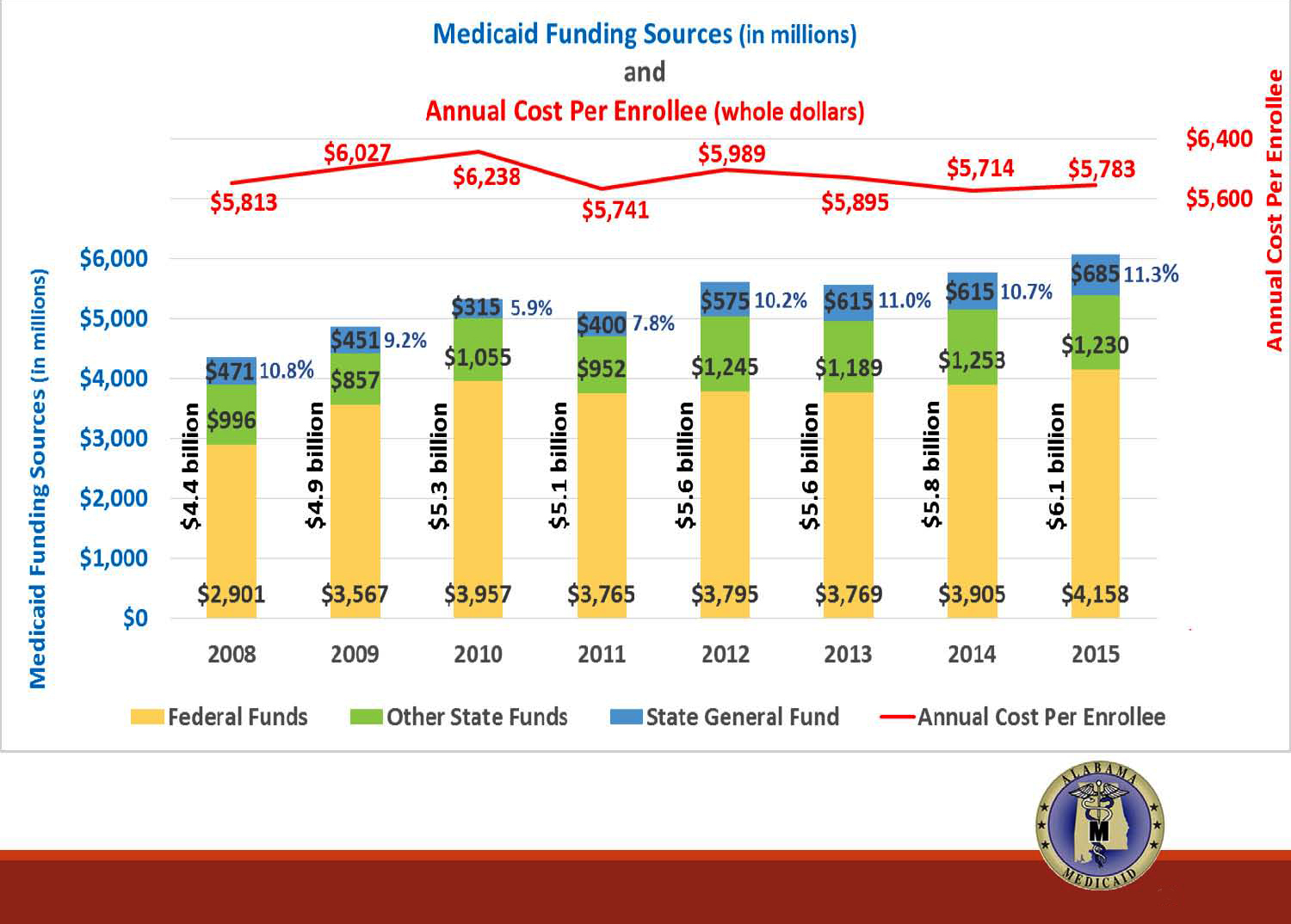
On Wednesday, Azar gave an overview of the Medicaid Agency, its eligibility requirements and its funding to the Joint Medicaid Study Group. The group, composed of select members of the House and Senate budget committees, wants to contain Medicaid costs, but is not expected to make any changes during the current legislative session that is just two weeks from completion. The Medicaid budget accounts for 38 percent of the state’s general operating budget. The agency provides medical care for close to 25 percent of the state’s population and underpins the state’s entire healthcare industry. Azar showed that while Medicaid has kept its per enrollee cost about level, the number of Medicaid recipients has grown by almost 300,000 since 2008. The percentage of Medicaid’s total funding that comes from the state’s General Fund also is at about the 2008 level, she said. The 2017 General Fund budget is $85 million short of what the agency says it needs to operate and establish the RCOs, which are intended to improve care while reducing costs.
HEALTH
Senate Approves Bill Granting Anti-Trust
Liability Immunity to Pharmacy Board
The Alabama Board of Pharmacy and its members would have liability immunity for adopting pharmacy rules that prioritize “patient safety and wellness but may be anti-competitive,” under a Senate bill that is ready for House consideration.
The House Health Committee on Wednesday approved SB310 by Sen. Billy Beasley, D-Clayton. The bill doesn’t lessen or expand the rights and privileges of those governed by the pharmacy board nor does it lessen or expand the pharmacy board members duties “in any context outside of federal or state antitrust immunity” beyond what existed prior to the Feb. 25, 2015, U.S. Supreme Court ruling in the N.C. State Board of Dental Examiners v. Federal Trade Commission case. That ruling held that professional licensing boards don’t automatically get antitrust immunity. In the 6-3 ruling, the nation’s highest court found that the dental examiners board, which was made up primarily of dentists, could not exclude non-dentists from the market for teeth-whitening services.
SB310 requires the board to document the public safety and wellness of any anti-competitive rule.
The House companion, HB320 by Rep. Ron Johnson, R-Sylacauga, also awaits consideration by the full House.
LEGAL
Senate Judiciary OKs Upping
District Court Jurisdiction by $5,000
The Senate Judiciary Committee on Wednesday approved increasing district courts’ jurisdiction from all cases involving $10,000 or less in controversy to all cases of $15,000 or less. Circuit courts would then have jurisdiction in matters exceeding $15,000 under HB151 by Rep. David Faulkner, R-Birmingham. The bill now goes to the full Senate.
ALCOHOL
Sunday Sale Referendums
in Rainbow City and Kellyton Rest with Governor
The Alabama Senate gave final approval to two Sunday sales bills this week:
- HB381 by Rep. Mack Butler, R-Rainbow City, authorizes the Rainbow City Council to ask voters in that city if they would like to allow alcohol sales between 1 and 9:30 p.m. on Sundays.
- HB274 by Rep. Ron Johnson, R-Sylacauga, gives the Kellyton Town Council authority to ask voters if they would like to allow alcohol sales after 1 p.m. on Sundays in that Coosa County town.
Both bills await the governor’s signature to become law.
Bill Allows Sunday Sales Referendums in Incorporated
as Well as Unincorporated Tallapoosa County
The Alabama House on Thursday approved HB549 by Rep. Mark Tuggle, R-Alexander City, which allows Tallapoosa County voters in any of the county’s municipalities to authorize Sunday alcoholic sales in a referendum. It also authorizes the county commission to call a Sunday sales referendum for the unincorporated areas of the county. The bill awaits consideration by the Senate Local Legislation Committee.
NEXT LEGISLATIVE DAY
The Alabama Senate and House of Representatives will convene at 1 p.m. Tuesday, April 26, for the 26th legislative day of the Alabama Legislature’s 2016 regular session.


